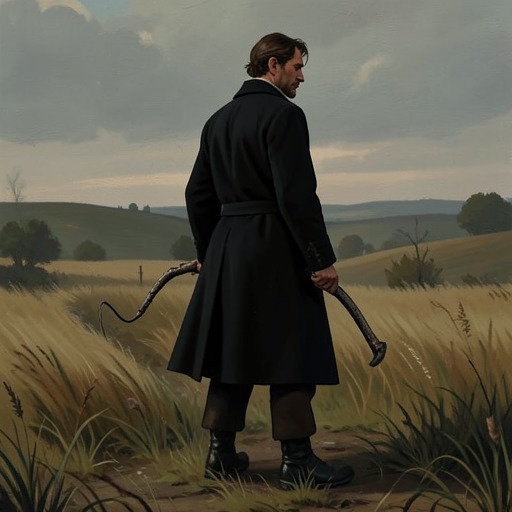
Gilbert assaults Frederick Lawrence
The Tenant of Wildfell HallGilbert assaults Frederick Lawrence after interpreting his own disappointment as grounds for anger against a man who had warned him not to expect what he hoped for. The sudden blow turns a personal grievance into physical violence, then gives way to uneasy concern and a belated return to help. Because the episode is related within Gilbert’s retrospective account to Halford, it shows both what he did and how his later narration attempts to judge the act.
Causes and Context
The immediate cause is Gilbert’s frustrated hope concerning Helen. Lawrence asks why Gilbert quarrels with his friends merely because he has been disappointed, and reminds him that he had warned him beforehand. Lawrence’s words identify the assault as displaced anger: Gilbert attacks the person confronting him rather than addressing the disappointment that has provoked him.
Gilbert’s response is abrupt. He seizes his whip by the small end and strikes Lawrence, then sees him fall from his pony. The force of the act is clear in Gilbert’s momentary fear that he may have killed him. Yet the victim is not dead: Lawrence moves and groans, and Gilbert concludes that the fall has only stunned him. The episode pivots quickly from aggression to alarm, without erasing Gilbert’s responsibility for having caused the fall.
The Assault and Its Immediate Aftermath
Gilbert initially leaves Lawrence beside the road, muttering an execration and spurring his own horse away. He admits that his feelings as he rides off are difficult to analyze, and suspects that his exultation in what he has done would not reflect well on his disposition. His account therefore records not just the assault but the morally compromised satisfaction that follows it.
He later returns, finding that Lawrence and the pony have moved: the pony has wandered several yards farther away, while Lawrence has managed to get off the roadway and sit on the bank. His clothes are muddy, his hat has rolled into the mud across the road, and he is still pale and unwell. Lawrence appears chiefly concerned about his pony, looking toward it with helpless anxiety. These practical details replace the apparent finality of the fall with a scene of recovery, but do not make Gilbert’s earlier abandonment harmless.
Gilbert recognizes that he ought to have helped Lawrence despite his indignation, including tending the wound he could not staunch and ensuring that he got home safely. The admission marks a change in his conduct, but it comes after he has already left the injured man alone. His return thus registers conscience and partial responsibility rather than cancelling the initial act.
Relationships and Conflict
The assault damages the friendship between Gilbert and Lawrence by turning disappointment into an accusation Lawrence has not earned. Lawrence’s measured reply points out that Gilbert is blaming a friend for his own defeated hopes; Gilbert’s violence makes the rupture more than a disagreement. The confrontation also places Gilbert’s passionate response beside Lawrence’s quiet tone, a contrast that emphasizes Gilbert’s failure of self-command.
The incident belongs to a larger misunderstanding around Helen and Lawrence. Gilbert’s hopes have been disappointed, and his anger falls on Lawrence, whom he regards as implicated in that disappointment. Later, Gilbert discovers that the end of Helen’s manuscript has been torn away. Its surviving fragment breaks off just as it is about to mention the parish’s self-styled fine gentleman and beau; Gilbert assumes that it was about to refer to him, though not favourably. The missing pages preserve uncertainty rather than confirming his suspicions, underscoring how partial evidence and Gilbert’s own interpretations shape the conflict.
Retelling and Consequences
Gilbert tells Halford that this account is the first instalment of his debt and offers to send the rest at his leisure. The framing presents his narrative as a selectively delivered personal record: he offers the listener the choice of receiving more, while retaining the material if Halford prefers not to hear it. Within that arrangement, the assault becomes part of Gilbert’s retrospective self-presentation, not an impersonal report.
The later return to the scene complicates that self-presentation. Gilbert gives himself credit for listening promptly to conscience, but his own account shows that he had first ridden away, leaving Lawrence to recover without the help he admits he should have provided. The difference between the self-congratulatory judgment and the sequence of actions makes his narration revealing even where it does not offer a neutral verdict.
The assault also precedes the transfer of Helen’s manuscript into Gilbert’s hands. When Helen gives it to him, she asks him to read it and to tell no one what it reveals, trusting his honour. He begins reading it that night, and the embedded narrative supplies the history that Gilbert’s earlier assumptions could not establish. The assault is therefore an important point in the frame story: it exposes the consequences of Gilbert’s premature judgment, while the manuscript that follows changes the reader’s understanding of Helen and Lawrence.
Narrative Significance
The episode is a reversal in Gilbert’s pursuit of understanding: anger produces an act he cannot wholly justify, and the physical danger of Lawrence’s fall gives way to the moral unease of Gilbert’s departure and return. Its significance lies not in violence as spectacle but in the gap between Gilbert’s claimed attention to conscience and the conduct he recounts. The scene also makes the limits of his perspective visible. He has acted on disappointment before knowing the history Helen’s manuscript will disclose, and his later account invites the reader to distinguish what happened from the explanations he places around it.